

 Seller
 Buyer

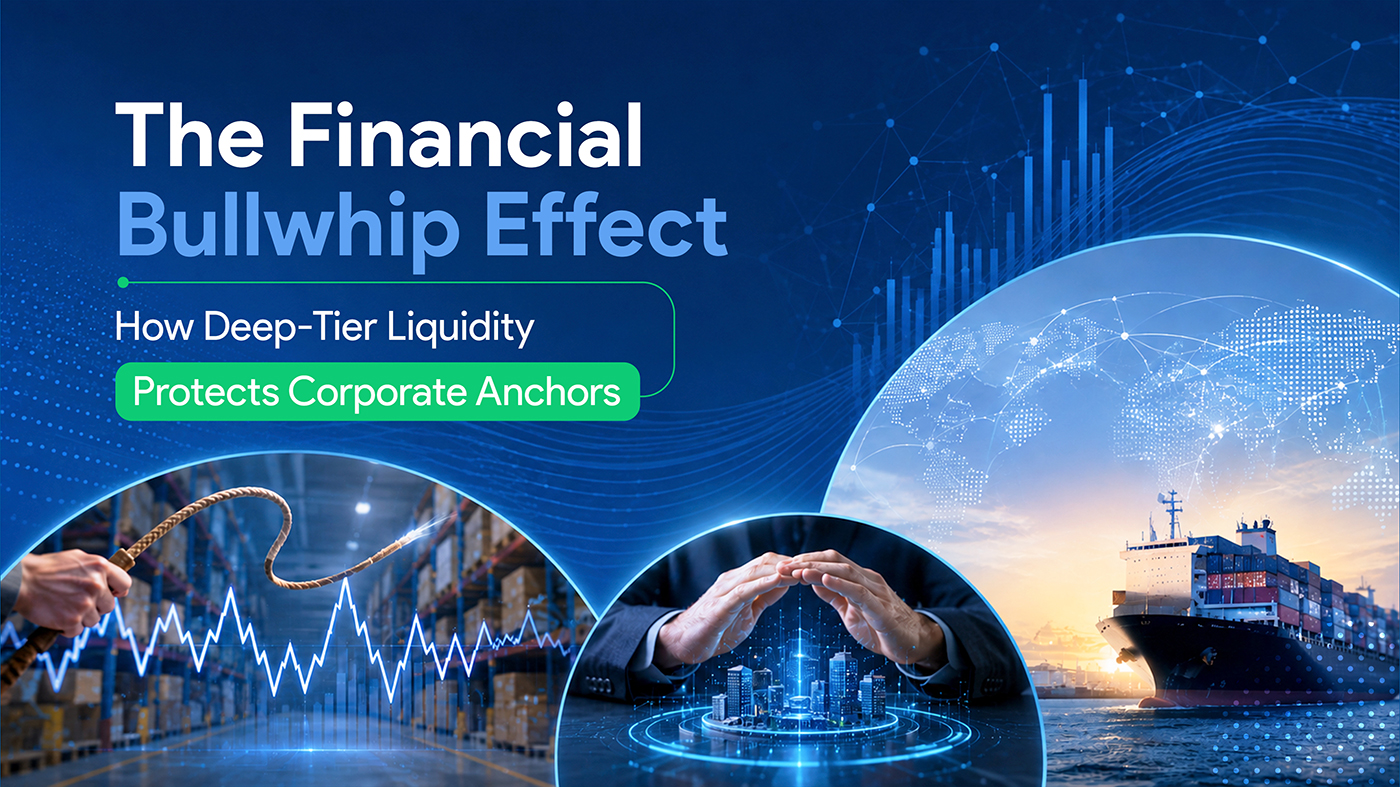
Supply chain resilience depends on how far liquidity can travel.
A corporate anchor may pay its immediate suppliers on time and still operate with financial vulnerability deeper in its supply chain. A Tier-1 supplier fulfilling a large manufacturing order often depends on Tier-2 enterprises for components, machining, packaging, or processing. In contrast, those businesses may depend on still smaller Tier-3 suppliers for materials and specialized services.
As commercial demand travels through these layers, so does the need for working capital. The challenge emerges when liquidity does not travel with the same efficiency. This is where Deep-Tier Supply Chain Financing becomes increasingly relevant—not only as an MSME financing solution, but as a mechanism for strengthening the resilience of the entire supplier ecosystem.
What Is the Financial Bullwhip Effect?
The conventional bullwhip effect describes how relatively small changes in demand can create increasingly larger fluctuations in orders, inventory, and production as they move through a supply chain. A similar amplification can occur with working capital pressure.
Consider an illustrative manufacturing order worth ₹1 crore. The Tier-1 supplier may need ₹40 lakh of components from Tier-2 businesses before it can complete production. A Tier-2 manufacturer may, in turn, need ₹15 lakh of materials or specialized processing from Tier-3 suppliers. Each business incurs costs before the final payment from the original order flows through the chain.
If the Tier-3 supplier operates on a 45- or 60-day receivable cycle, increased demand can actually increase its immediate cash requirement. More orders require more material, labor, and production capacity even though payment for previous supplies may still be outstanding.
The commercial opportunity has moved from the corporate anchor through Tier-1, Tier-2, and Tier-3. The liquidity supporting that opportunity may not have moved as far.
That is the financial bullwhip: a working capital constraint several relationships away from the corporate anchor can eventually translate into a procurement, capacity or delivery issue much closer to it.
Why Corporate Anchors Need Visibility Beyond Tier-1
Corporate procurement and treasury teams understandably have the strongest visibility into their direct suppliers. They know the purchase orders issued, the commercial terms agreed, the invoices approved, and the delivery performance expected from Tier-1 vendors.
However, a Tier-1 supplier’s ability to fulfill an order may depend on businesses the corporate never contracts with directly.
An automotive manufacturer, for example, may source an assembly from a large Tier-1 vendor. That vendor may depend on a smaller enterprise for precision-machined components, while the component manufacturer relies on another MSME for specialized material or finishing.
If the Tier-3 business needs ₹15 lakh to procure material for the next production cycle but a significant part of its working capital remains tied up in receivables, the impact does not remain confined to that enterprise. Lower production at Tier-3 can constrain Tier-2 supply, which can affect Tier-1 assembly and, eventually, the corporate production schedule.
The financial constraint may begin several commercial relationships away. The operational consequence can still reach the anchor.
This is why MSME Supply Chain Finance increasingly needs to be viewed as an ecosystem question rather than only a direct-vendor financing program.
How Working Capital Pressure Amplifies Through the Supply Chain
Larger corporates typically have access to multiple sources of capital through banking relationships, treasury infrastructure and established credit lines. Large Tier-1 suppliers may also have formal working capital facilities.
The financing environment can narrow as transactions shift towards smaller businesses. Yet the cash requirement generated by an order does not become smaller simply because the supplier sits deeper in the chain.
Suppose demand at a corporate anchor increases by 20%. Its Tier-1 supplier may need additional components to meet the new production schedule. That requirement becomes additional orders for Tier-2 suppliers, which can translate into additional purchases from Tier-3 businesses.
For those deeper suppliers, growth in orders creates a financing requirement before it creates cash. Raw materials need to be purchased, workers paid, production scheduled and logistics arranged while receivables from previous orders may still be awaiting settlement.
The result is an important working-capital paradox: a growing order book can increase short-term liquidity pressure.
Deep-tier financing addresses this point in the commercial cycle by linking access to working capital more closely to validated trade activity.
Where TReDS for MSMEs Addresses the First Financing Layer
TReDS for MSMEs has created a formal digital mechanism through which eligible MSME trade receivables can be financed through multiple financiers. Under the RBI-defined TReDS process, invoices or bills are represented as Factoring Units, accepted by the relevant counterparty, opened for bidding by financiers, and discounted after selection of a suitable bid. The financier pays the MSME seller, while the buyer settles with the financier on the due date.
For an MSME supplying directly to a participating corporate, PSU, government department, or another eligible buyer, MSME Invoice Financing can convert an approved receivable into earlier liquidity, rather than requiring the supplier to wait until the contractual payment date.
This has made TReDS an important part of the formal MSME financing ecosystem.
The deeper financing question, however, arises when the supplier does not invoice the large corporate directly.
A Tier-2 enterprise may sell to a Tier-1 business that is itself an MSME. Similarly, a Tier-3 supplier may raise its invoice on another MSME rather than on the corporate anchor at the top of the chain.
This is the point at which S2S Financing extends the financing conversation deeper into the supplier network.
From Conventional Anchor-Led TReDS to Deep-Tier S2S Financing
M1xchange’s Small-to-Small (S2S) Financing model enables financing for transactions in which an MSME buyer procures goods or services from another MSME supplier. It extends structured, transaction-linked financing to Tier-2 and Tier-3 suppliers that may not have a direct commercial relationship with a large corporate anchor.
The distinction can be seen clearly:
| Conventional Anchor-Led TReDS | Small-to-Small (S2S) Financing |
| Large/eligible buyer → MSME supplier | MSME buyer → MSME supplier |
| Primarily addresses the direct supplier relationship. | Extends financing into deeper supplier tiers |
| Approved receivable supports invoice discounting | Validated MSME-to-MSME transaction supports financing. |
| Strengthens liquidity at the visible supplier layer | Helps liquidity travel further through the supply chain |
| Focuses primarily on direct MSME receivables | Expands Deep-Tier Supply Chain Financing to Tier-2 and Tier-3 relationships |
M1xchange describes S2S Financing as an extension of financing beyond the conventional corporate-to-MSME use case, enabling an MSME buyer to finance procurement from another MSME supplier.
The result is important for MSME Supply Chain Finance: financing can begin to follow the actual structure of commerce rather than stopping where the corporate’s direct supplier list ends.
What Deep-Tier Protection Looks Like in Practice
Consider the earlier ₹1 crore order.
The corporate anchor places the order with Tier-1. Tier-1 procures ₹40 lakh of components from Tier-2. Tier-2 then procures ₹15 lakh of materials and services from Tier-3.
Financing the corporate-to-Tier-1 receivable can strengthen liquidity at the first relationship. But Tier-2 and Tier-3 still have their own invoices, production cycles, and working capital requirements.
Through S2S Financing, an eligible MSME supplier can receive earlier payment against an approved invoice raised on a participating MSME buyer. This creates a financing layer around the MSME-to-MSME commercial relationship itself. M1xchange states that the model uses cash-flow and transaction-based assessment, reducing dependence on traditional physical collateral, subject to the financier’s credit policy.
Instead of waiting for financial pressure at Tier-3 to move upward through production and procurement, liquidity can address the requirement closer to where the transaction originates.
That is the fundamental protection offered by deep-tier financing.
The Corporate ROI of Stronger Deep-Tier Liquidity
For a corporate anchor, the value of Deep-Tier Supply Chain Financing is not limited to whether an MSME receives payment earlier. Its larger value lies in what stronger liquidity across the ecosystem can enable.
- Zero Debt on Anchor Balance Sheet: S2S financing funds Tier-2 and Tier-3 vendors based on their own transaction data. The corporate anchor secures a supply chain without providing guarantees or adding debt to its books.
- Uninterrupted Production: Prevents vital parts from getting stuck simply because a small sub-vendor cannot afford raw materials.
- Faster Response to Demand Spikes: When you increase order volume, deeper suppliers can fund raw materials instantly instead of waiting weeks for cash.
- Lower Supply Chain Friction: Procurement teams avoid last-minute supplier emergencies and delivery delays.
- Better ESG & Vendor Health: Promotes financial inclusion and sustainability deep within your vendor ecosystem.
TROI, therefore, is not simply a financing-rate calculation. It can be assessed through operational outcomes such as continuity, capacity utilization, procurement stability, supplier retention, and the ecosystem’s ability to respond to growth.
S2S Financing Is Moving from Concept to Scale
The adoption data gives this shift more context.
In June 2026, M1xchange reported that its S2S Financing platform had crossed ₹1,400 crore in year-to-date throughput, with monthly transaction volumes of approximately ₹100 crore. S2S throughput had increased 556% year-on-year, while the buyer base expanded 102%.
The financier network had grown by 50% to 21 lending partners, while M1xchange reported 99.99% repayment performance. Approximately 20% of MSME buyers had enabled both payables and receivables financing, helping those businesses manage liquidity on both sides of their commercial cycle and participate in larger procurement opportunities.
These numbers matter because they show that MSME-to-MSME financing is not merely a theoretical extension of traditional supply chain finance. It is becoming an active financing layer within deeper supplier relationships.
From Anchor Credit to Transaction Intelligence
Moving financing deeper into the supply chain also changes how credit needs to be assessed.
In a conventional anchor-led transaction, the credit standing of a large corporate buyer provides an important reference point. In an MSME-to-MSME transaction, the immediate buyer may itself be a smaller enterprise.
M1xchange powers this through its proprietary Credit Analytics Engine (CAE). Instead of relying on physical collateral or corporate anchor guarantees, the CAE evaluates verified digital data—including GST returns, Account Aggregator banking trails, and past TReDS repayment records—to assess credit risk and automatically approve financing.
This shifts the financing lens from one predominantly focused on the presence of a large anchor to one that also considers the underlying business, cash flows, and transaction behavior.
For MSME Invoice Financing, that distinction is significant. Formal credit assessment can move closer to where actual business activity is occurring, helping eligible enterprises participate in structured financing even when the immediate buyer is another MSME.
Deep-Tier Financing Also Supports Responsible Sourcing
Responsible sourcing increasingly requires companies to consider the health of the ecosystem behind their direct vendors, not only the commercial performance of Tier-1 vendors.
Financial resilience is part of that picture. When smaller suppliers have access to transparent, formal and transaction-linked financing channels, corporates can support a supply chain environment in which growth is less dependent on opaque or informal sources of working capital.
From an ESG perspective, Deep-Tier Supply Chain Financing can therefore complement responsible-sourcing objectives by supporting greater financial inclusion, formalization and resilience among smaller enterprises embedded within the value chain.
The corporate may not be the borrower in an S2S Financing transaction, but it can still benefit from a deeper supplier ecosystem better equipped to sustain production and support future growth.
From Supply Chain Finance to Supply Chain Infrastructure
India’s supply chains do not end at Tier-1. Manufacturing, automotive, engineering, consumer products and other industries depend on networks of businesses that create value across several layers before a finished product reaches the market.
Financing architecture needs to recognize the same reality.
TReDS for MSMEs addresses an important part of the working-capital challenge by enabling eligible MSME receivables to be financed through a formal digital marketplace. S2S Financing takes that logic further by creating a financing route around MSME-to-MSME commercial relationships.
The difference is more than another source of credit.
It means MSME Supply Chain Finance can begin to operate as infrastructure across the supplier ecosystem—connecting liquidity with the transactions, production activity, and commercial relationships that actually keep the supply chain moving.
Managing the Financial Bullwhip Before It Reaches the Anchor
A financially constrained Tier-3 supplier may appear distant from the corporate anchor. Operationally, however, it can be only a few dependencies away.
Deep-tier liquidity addresses financial pressure closer to its source. Through eligible MSME-to-MSME transactions, financing can follow commercial activity further into the network rather than waiting for a liquidity constraint to become visible as a delayed component, a missed production schedule, or a procurement problem.
That makes S2S Financing fundamentally different from reactive supplier support.
The objective is to strengthen the financing mechanism while the supply chain is functioning normally—so that businesses with viable orders have a structured route to working capital as they procure, produce and supply.
For corporate anchors, this introduces a broader question into supply chain strategy.
It is no longer sufficient to ask whether direct suppliers are financially strong. Corporates also need to consider whether liquidity can reach the businesses those suppliers depend upon.
M1xchange’s S2S financing is designed to extend that reach by enabling Deep-Tier Supply Chain Financing for eligible MSME-to-MSME transactions, strengthening the financial links that support the businesses large corporates rely on. The platform’s ₹1,400+ crore YTD throughput and 556% year-on-year growth reported in June 2026 indicate the growing relevance of that model within India’s MSME financing ecosystem.
Protect Your Supply Chain Against Hidden Liquidity Bottlenecks
Your business is only as strong as your deepest supplier. Discover how S2S Financing by M1xchange insulates your Tier-2 and Tier-3 vendors with zero impact on your balance sheet.
Last modified: August 21, 2026