

 Seller
 Buyer
Buyer
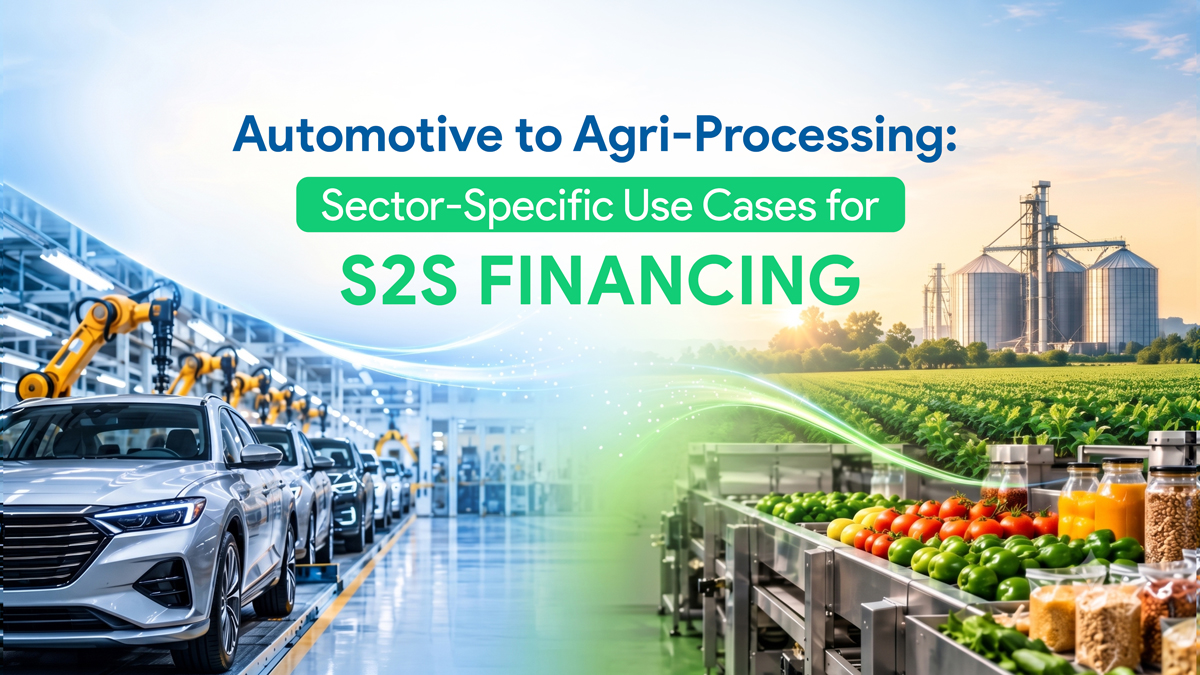
India’s largest supply chains rarely stop at the Tier-1 supplier.
A vehicle manufacturer depends on component makers that depend on casting, machining and material suppliers. A garment manufacturer depends on processors that depend on weaving, knitting and spinning businesses. An FMCG company may sit at the visible end of a network that extends through contract manufacturers, processors, packaging suppliers and logistics providers.
The order moves through every tier. The working-capital requirement does too.
This is where a gap emerges in conventional supply-chain financing.
Traditional TReDS primarily brings receivables financing to eligible transactions between MSME suppliers and corporate or other eligible buyers. But much of the commercial activity required to fulfill that final order can take place earlier in the chain, between one MSME and another.
An MSME component manufacturer may buy from a smaller machining business. A garment manufacturer may buy from an MSME processor. A food processor may depend on an MSME packaging supplier.
In each case, the smaller business completes its part of the order and then waits for its MSME buyer to pay, even as its next production run has already begun.
S2S financing extends the framework to eligible MSME-to-MSME transactions. An eligible MSME buyer validates its supplier’s invoice, enabling the supplier to access financing against that receivable, subject to financier assessment and sanction.
That changes where financing can enter a multi-tier supply chain. It no longer has to begin only when the commercial chain reaches a large corporate buyer.
Automotive and Manufacturing: When a Tier-3 Liquidity Gap Reaches the Assembly Line
Consider an automotive production order moving through three levels.
An OEM places a higher-volume requirement with a Tier-1 component manufacturer. The Tier-1 business increases its requirement from a Tier-2 sub-assembly supplier. That supplier, in turn, needs a Tier-3 casting or machining unit to increase output.
The Tier-3 business must now procure more raw material, run additional machine hours, and meet a larger production schedule. But cash from the previous supply cycle may still be sitting in receivables.
This is no longer an isolated financing problem at Tier-3.
If the casting or machining unit cannot fund production, the Tier-2 supplier may not receive the required parts on schedule. That can delay the sub-assembly supplied to Tier-1 and, ultimately, put the OEM’s production schedule at risk.
A working-capital constraint several transactions away from the OEM can therefore become a production constraint for the entire chain.
The commercial relationship relevant to S2S may look like this:
Tier-2 MSME Buyer → purchases from → Tier-3 MSME Supplier
Once the smaller supplier completes the eligible transaction and raises an invoice, the MSME buyer can validate that invoice through the S2S process. Subject to financier assessment and sanction, the supplier can access financing against the receivable while the MSME buyer settles the financed amount on the applicable due date.
The value of deep-tier financing in automotive is therefore specific: liquidity can reach businesses producing the castings, machined parts, materials, and specialized inputs on which higher tiers depend.
Instead of waiting for a liquidity constraint to travel upwards as a supply disruption, financing can be introduced against an eligible trade transaction where the working-capital requirement actually occurs.
Textiles and Apparel: Financing the Gap Between One Production Cycle and the Next
Textile production moves through a series of specialized businesses.
Fiber moves into spinning. Yarn moves into weaving or knitting. Fabric goes through processing. Processed fabric then moves into garment manufacturing.
The working-capital challenge arises from the timing between these stages.
Consider a spinning business that supplies yarn to an MSME weaving unit on commercial credit. The yarn has been delivered and the invoice raised, but payment is due later.
The spinning unit, however, cannot necessarily wait for that receivable to mature before beginning its next production cycle. It may already need to procure fiber, cover labor costs, and run machinery for the next order.
The same situation can repeat further along the chain. A processor may complete a batch of fabric for a garment manufacturer but need chemicals, labor and operating capital for its next processing run before the previous invoice is paid.
Production cycles can therefore turn faster than payment cycles.
Where the underlying transaction is between eligible MSMEs, S2S financing provides a route to address this timing mismatch. The MSME buyer validates the eligible supplier invoice, and the supplier can seek financing against that receivable subject to financier assessment and sanction.
This is particularly relevant to textiles because liquidity requirements do not occur at one fixed point. They recur as material moves through spinning, weaving, processing and garment production.
Deep-tier financing can therefore help prevent an outstanding receivable at one production stage from becoming the funding constraint for the next.
Agri-Processing and FMCG: Financing Seasonal Procurement and Contract Manufacturing Networks
Agri-processing introduces a different working-capital pressure: the procurement window may be considerably shorter than the commercial payment cycle.
Agricultural processing networks can involve collection and aggregation, primary processing, storage, further processing, packaging, logistics and manufacturing before a finished product reaches the market.
When procurement is concentrated around a harvesting or seasonal sourcing period, businesses in this network may need to mobilize working capital quickly. Waiting for existing B2B receivables to mature can limit how much material they can procure, process, or package during that window.
Consider an MSME processor supplying a contract manufacturer while simultaneously needing packaging material or processing services from another MSME. Or an MSME contract manufacturer preparing a larger FMCG production run while its packaging supplier needs liquidity to procure additional films, cartons and labels.
The visible demand may originate with a large FMCG brand, but the immediate working-capital requirement can sit several transactions further upstream.
S2S is relevant where those underlying commercial transactions are eligible MSME-to-MSME B2B transactions.
When an eligible MSME supplier raises an invoice on an eligible MSME buyer, that invoice is validated on the platform—allowing receivables financing to be unlocked subject to financier assessment.
This can be particularly useful during concentrated procurement or production periods because liquidity does not necessarily have to wait until the wider downstream cycle has concluded.
The distinction is important: S2S finances eligible B2B trade receivables between MSMEs. It should not be positioned as direct farm-gate or farmer financing.
For agri-processing and FMCG networks, its role is deeper in the commercial chain—across eligible processing, packaging, storage, logistics, and contract-manufacturing relationships where MSME trade credit creates a working-capital gap.
Why Sector Structure Matters for S2S Financing
The pressure point differs by industry. Automotive can face cascading dependencies across component tiers; textiles can face payment cycles that extend beyond the next production requirement; agri-processing and FMCG can face concentrated procurement and production windows.
The common financing question is simpler: where has an MSME completed an eligible transaction for another MSME but remains short of liquidity because cash is still locked in the receivable?
The Technology Bridge: Assessing the MSME Buyer Behind the Invoice
Extending financing from corporate-led TReDS transactions into MSME-to-MSME trade changes an important part of the credit equation.
In an S2S transaction, the buyer itself is an MSME. The financier therefore needs sufficient visibility into that buyer’s financial position and transaction behavior before deciding whether to finance invoices it validates.
M1xchange addresses this assessment requirement through its Credit Analytics Engine (CAE).
CAE brings together key digital financial and transactional signals:
- GST Data: Verifying active sales flow and operational volume
- Banking Data: Assessing operational liquidity and day-to-day cash movements
- TReDS Transaction History: Evaluating historical repayment discipline and trade behavior
These signals support the assessment of parameters such as financial strength, transaction behavior, payment capacity, and payment intent.
The process can be represented as:
Business Data → Financial & Transaction Analysis → Credit Intelligence → Financier Rule Engine → Transaction Integration
This is particularly relevant for deep-tier financing because credit assessment cannot depend only on the traditional relationship-led or physical-collateral-led approach to MSME lending. Digital business and transaction signals provide another layer of information to evaluate the MSME buyer.
The distinction between the two layers remains important:
S2S is the financing mechanism. CAE is the intelligence layer supporting credit assessment.
CAE does not replace the financier’s credit decision. It structures available financial and transactional information so participating financiers can evaluate opportunities in accordance with their own credit policies and rule engines.
This creates the technology bridge required to evaluate a broader universe of MSME buyers as financing moves deeper into multi-tier supply chains.
From Sector Use Case to Deep-Tier Financing Strategy
The practical starting point for S2S is not the size of the anchor at the top of the supply chain. It is identifying the MSME-to-MSME transactions underneath it.
In automotive, that may be the component manufacturer buying from a machining or casting unit. In textiles, it may be the garment manufacturer buying from a processor or the weaving unit buying from a spinner. In agri-processing and FMCG, it may be the processor or contract manufacturer buying from an eligible packaging, storage, or service provider.
Across each case, the question is the same:
Where is an MSME supplier extending trade credit to another MSME, and can that eligible receivable be financed before the payment cycle becomes a production constraint?
M1xchange S2S enables deep-tier financing across eligible MSME-to-MSME transactions, while CAE supports the credit intelligence financiers need to assess MSME buyers deeper in the supply chain.
For enterprise anchors, the opportunity is to look beyond Tier-1 and identify where liquidity constraints among Tier-2 and Tier-3 vendors can create upstream production risk.
For eligible MSME buyers, the opportunity is to enable suppliers across the vendor network to seek financing against validated invoices without requiring the buyer to bring forward its applicable payment date.
Don’t let a deeper-tier liquidity gap become your next supply-chain bottleneck.
Explore S2S Financing by M1xchange.
Last modified: September 24, 2026