

 Seller
 Buyer
Buyer
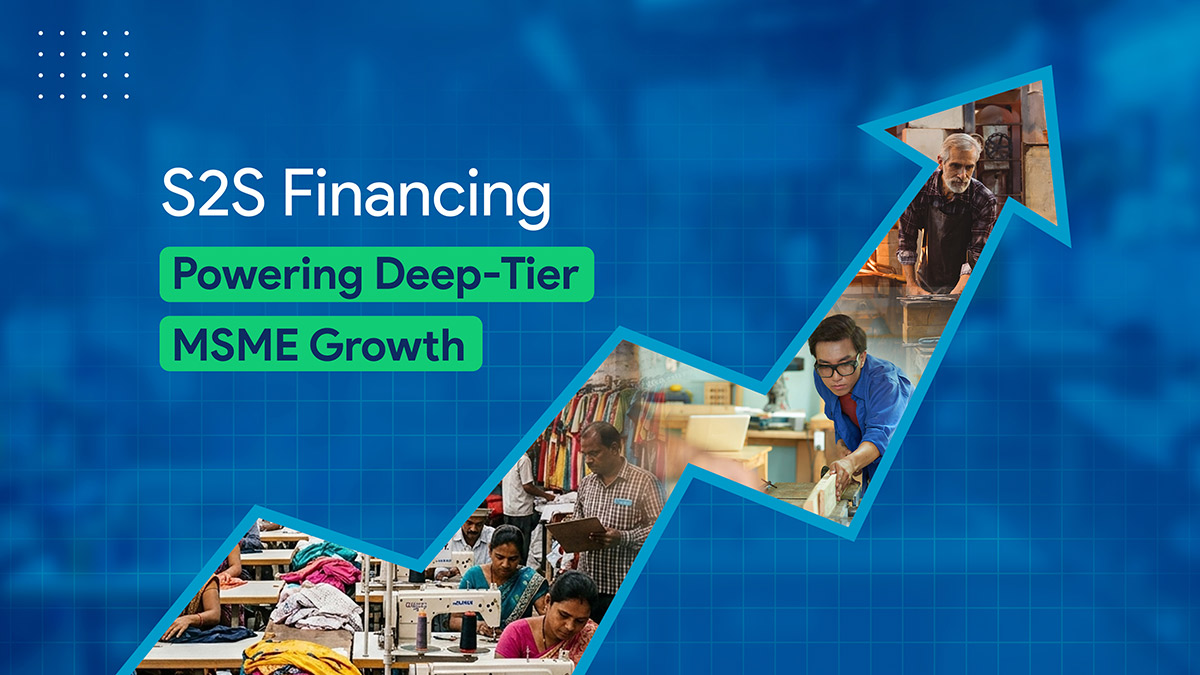
S2S financing is emerging as a critical enabler for expanding formal credit access across India’s supply chains. While traditional trade finance models largely serve anchor-linked vendors, millions of deep-tier MSMEs remain outside the formal credit net due to limited collateral, low financial visibility, and fragmented transaction data. The process required today is not incremental lending expansion but structural digitisation of supply chain finance.
This is where S2S financing plays a transformative role. By extending financing visibility beyond the first tier of suppliers, it enables unsecured, data-backed credit access deeper into the ecosystem. In India, where the MSME sector continues to face a significant formal credit gap, regulated digital trade finance frameworks such as TReDS have already demonstrated how technology-led platforms can unlock structured liquidity. Building on this evolution, the S2S model pushes credit inclusion further downstream. This blog explains what deep-tier MSMEs are, why they struggle to obtain credit, how the S2S model works, and how digital platforms are enabling scalable, secure access to working capital.
What Is S2S Financing?
S2S financing (“Small-to-Small” Financing) is a structured supply chain financing model that extends credit beyond the immediate anchor–vendor relationship to multiple downstream supplier tiers. Unlike conventional receivables finance, which typically stops at Tier-1 vendors, S2S frameworks:
- Map multi-tier supply chain relationships
- Digitise transaction flows across layers
- Enable financiers to evaluate risk using trade data
- Facilitate unsecured working capital access deeper into the chain
At its core, S2S financing transforms supply chain data into a financeable asset, allowing liquidity to flow where traditional banking models have limited reach. While TReDS platforms have formalised invoice discounting between anchors and their immediate vendors, S2S financing operates alongside this regulated framework to extend visibility into deeper supplier layers. As a licensed TReDS platform, M1xchange is strategically positioned to support this evolution by combining regulatory discipline with data-led supply chain intelligence.
Understanding Deep-Tier MSMEs
Who Are Deep-Tier MSMEs?
Deep-tier MSMEs are suppliers positioned two or more layers away from large corporate anchors. Despite their distance from the anchor, these enterprises often support critical production inputs, specialised components, or regional distribution nodes. From an anchor risk perspective, financial stress at deep tiers can trigger upstream disruptions, making their liquidity health an important determinant of overall supply chain continuity and resilience. These businesses often include:
- Component manufacturers
- Sub-contractors
- Raw material suppliers
- Regional distributors
Despite being integral to production continuity, they typically operate with low financial visibility.
- Why Deep-Tier MSMEs Struggle to Access Credit
- Several structural barriers limit formal financing access:
- Limited Collateral Availability
Most deep-tier MSMEs operate asset-light models and cannot meet traditional collateral requirements, restricting access to secured loans.
- Low Transaction Visibility
- Banks often lack verified data on their trade flows, making risk assessment difficult.
- Fragmented Supply Chain Linkages
Deep-tier players usually lack structured credit profiles.
High Cost of Traditional Lending
Traditional financing channels are often expensive, slow and impact working capital cycles.
As a result, a significant portion of India’s MSME ecosystem remains underfinanced despite strong underlying trade activity.
How S2S Financing Works
The strength of S2S financing lies in its ability to convert supply chain activity into structured credit signals. Unlike standard invoice discounting on TReDS, which is typically limited to confirmed invoices between anchors and first-tier vendors, S2S financing evaluates multi-tier trade relationships and transaction behaviour to extend flow-based credit deeper into the network. The process typically unfolds in a digitally orchestrated sequence within the M1xchange platform environment:
- Supply chain mapping identifies linkages beyond Tier 1 vendors
- Transaction data capture builds authenticated trade visibility.
- Risk analytics evaluate behavioural and payment signals.
- Lender participation enables unsecured, flow-based financing.
- Digital monitoring ensures ongoing performance tracking.
Through this structured flow, M1xchange operationalises deep-tier financing in a controlled, scalable manner.
The above mentioned process is explained in detail below:
Supply Chain Mapping
Identification of Multi-Tier Relationships
The first step involves digitally mapping supplier networks beyond the anchor level. This creates visibility into Tier-2, Tier-3, and deeper participants.
Anchor Linkage Validation
Even indirect linkage to strong anchors improves credit confidence, forming the foundation for flow-based underwriting.
Digital Onboarding of MSMEs: Paperless Registration
- Deep-tier suppliers are onboarded through digital workflows that reduce entry barriers.
- Standardised KYC and Verification
- Automated compliance checks ensure faster activation while maintaining regulatory rigor.
Through platforms such as M1xchange, this onboarding process is designed to scale efficiently across large supplier ecosystems.
Transaction Capture and Validation
Invoice Digitisation
Trade invoices are uploaded and authenticated within the platform environment.
Real-Time Visibility for Financiers
Structured data trails enable lenders to evaluate actual trade performance rather than relying solely on balance sheets.
This shift significantly reduces information asymmetry in MSME lending.
Data-Led Underwriting
Traditional MSME lending is balance-sheet heavy. In contrast, S2S financing relies on flow-based analytics.
- Key Evaluation Parameters
- Historical invoice performance
- Counterparty strength
- Payment behaviour
- Supply chain continuity
Because the assessment is data-driven, deep-tier MSMEs can access unsecured working capital even without substantial collateral.
Disbursement and Settlement
Once approved:
- Funds are disbursed quickly to the MSME
- Repayment aligns with actual trade cycles
- Liquidity flows programmatically across the chain
This creates a repeatable, scalable financing loop.
| Parameter | Traditional MSME Lending | S2S Financing |
| Credit Basis | Collateral-heavy | Cash-flow and trade data |
| Coverage | Mostly Tier-1 vendors | Multi-tier supply chain |
| Processing Speed | Slow and manual | Digital and faster |
| Risk Visibility | Limited | Data-driven |
| Scalability | Constrained | Network-driven |
| Regulatory Oversight [IA1] [kk2] | Operates within | TReDS, Regulated by RBI |
The comparison highlights why S2S financing is increasingly viewed as structural infrastructure rather than just another lending product.
TReDS vs S2S: How the Models Differ
The Trade Receivables Discounting System (TReDS) remains one of the most important structural reforms in MSME financing. Regulated by the Reserve Bank of India, TReDS platforms formalise invoice discounting between corporate buyers and their immediate (Tier-1) MSME vendors.
Licensed exchanges such as M1xchange operate under strict regulatory oversight to enable transparent receivables financing.
What TReDS Covers
TReDS is designed primarily for confirmed invoice discounting.
Core features
- Digital acceptance of invoices by corporate buyers
- Multi-financier bidding for price discovery
- Standardised documentation
- Defined settlement timelines
- Complete audit trails
Outcome:
TReDS reduces payment friction and improves liquidity for Tier-1 MSME suppliers.
Where S2S Financing Extends the Model
Small-to-Small (S2S) financing builds on the formal rails created by TReDS but addresses a different gap.
Key distinction
TReDS: Invoice-backed financing for Tier-1 vendors
S2S: Flow-based financing for deep-tier suppliers beyond Tier-1
While TReDS relies on accepted invoices, S2S evaluates multi-tier supply chain data and transaction behaviour to enable unsecured credit deeper in the ecosystem.
Outcome:
S2S expands credit reach where traditional invoice discounting cannot operate.
How M1xchange Bridges TReDS and S2S
As an RBI-licensed TReDS platform, M1xchange provides the regulated foundation for formal receivables financing. Building on this compliant infrastructure, the platform is progressively enabling deeper supply chain visibility that supports S2S-type financing flows.
Structured approach
- Regulated invoice discounting on TReDS establishes verified trade data.
- Supply chain mapping identifies relationships beyond Tier-1.
- Data-led risk analytics convert transaction trails into credit signals.
- Multi-lender ecosystem enables scalable liquidity deployment.
Why this matters
- Preserves RBI-aligned governance discipline
- Expands formal credit inclusion beyond Tier-1
- Strengthens anchor supply chain resilience
- Enables flow-based MSME financing at scale
TReDS formalised receivables financing for MSMEs. S2S builds on that foundation to push liquidity deeper into supply chains. Through its regulated platform architecture, M1xchange is positioned to support this evolution in a controlled, transparent, and scalable manner.
Why Unsecured Credit Through S2S Is a Transformative Step
Expands Formal Credit Inclusion
By evaluating real trade activity, S2S financing brings previously excluded MSMEs into the formal financial system, helping address India’s structural credit gap.
Improves Speed of Access
Digital workflows can significantly compress approval timelines significantly, often reducing turnaround from several weeks in traditional lending to a few working days in data-backed models.
Strengthens Supply Chain Resilience
When liquidity reaches deeper tiers, production disruptions decline, vendor dependencies stabilise, and anchors gain better continuity assurance.
Enables Scalable Growth
Because the S2S model is data-driven and documentation-light, it supports faster ecosystem expansion without proportional increases in manual processing overhead.
Enabling MSME Digitisation Through S2S Ecosystems
MSMEs must first become digitally visible participants in formal trade networks for S2S financing to scale meaningfully.
This is not merely a financing shift but an ecosystem transformation. M1xchange, as an RBI-licensed TReDS platform with a growing multi-lender network and deep corporate coverage is enabling this transition through structured digital infrastructure.
Structured Digital Onboarding
Standardised, compliance-aligned onboarding frameworks help deep-tier MSMEs enter formal financing networks with reduced friction.
End-to-End Transaction Visibility
Digitally authenticated invoices and trade trails strengthen lender confidence and improve risk transparency across the ecosystem.
Analytics-Driven Credit Assessment
By leveraging transaction data and behavioural insights, the platform supports unsecured credit evaluation aligned with actual business performance.
Network-Led Liquidity Expansion
As more anchors, MSMEs, and financiers participate, the platform’s network effects help extend formal liquidity deeper into supply chains.
S2S as a Scalable MSME Growth Engine
The future of MSME financing will likely be network-centric, data-driven, and deeply embedded within supply chains. S2S financing aligns closely with this direction.
Rather than treating MSME credit as isolated lending events, the model:
- Embeds finance within trade flows
- Scales through digital infrastructure
- Reduces reliance on collateral
- Expands institutional participation
For policymakers, financiers, and corporates, this represents a more sustainable path toward MSME formalisation and growth.
Conclusion
M1xchange’s S2S financing ecosystem is redefining how unsecured credit reaches deep-tier MSMEs by turning supply chain data into a reliable financing signal. As traditional lending models struggle to penetrate the long tail of suppliers, digitally enabled S2S ecosystems are creating a more inclusive and scalable credit architecture. By combining digital onboarding, transaction visibility, and data-led underwriting, the M1xchange TReDS platform is helping extend structured working capital access beyond the first tier of vendors. The shift is gradual but structural, moving the market from collateral-led lending toward flow-based finance. As S2S frameworks mature within regulated digital trade ecosystems, they are poised to play a defining role in reshaping India’s MSME credit architecture over the coming decade.
By combining digital onboarding, transaction visibility, and data-led underwriting, the M1xchange TReDS platform is helping extend structured working capital access beyond the first tier of vendors. The shift is gradual but structural, moving the market from collateral-led lending toward flow-based finance. As S2S frameworks mature within regulated digital trade ecosystems, they are poised to play a defining role in reshaping India’s MSME credit architecture over the coming decade.
Last modified: March 6, 2026